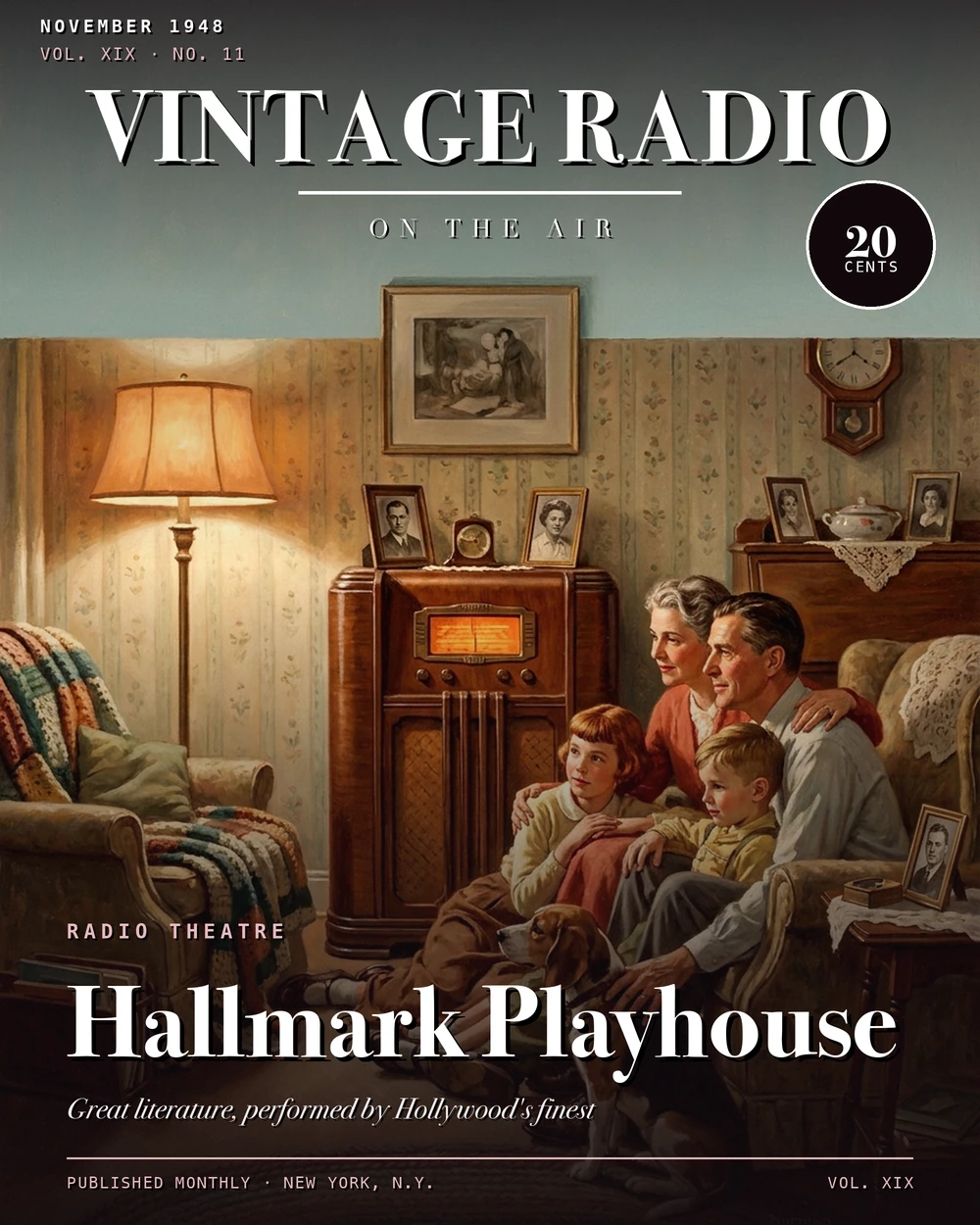
Hallmark Playhouse
A Greeting Card Company Bets Big on Literature
Most radio sponsors bought programs to move product. Hallmark — then operating as Hall Bros., Inc. under the familiar slogan "When you care enough to send the very best" — took a different approach. Rather than attach its name to a game show or variety hour, the company put its advertising dollars behind a serious dramatic anthology that adapted classic and contemporary literary works for a mass audience. By the end of 1948, Hall Bros. was on pace to spend roughly $1,500,000 per year on the program — reportedly about half of the company's entire advertising budget and around 10 percent of its gross income. That was not a casual commitment. It was a statement about what kind of company Hallmark wanted to be seen as.
Hallmark Playhouse began on CBS as a summer replacement for Radio Reader's Digest, which Hallmark had also sponsored. When the summer run ended, company executives decided to keep their new show and drop the Reader's Digest tie-in — they preferred the product identification to belong entirely to Hallmark rather than share it with another brand name. The show ran as a regular CBS series from June 10, 1948, airing in half-hour episodes until it was overhauled into The Hallmark Hall of Fame beginning February 8, 1953.
The Man Who Chose the Books
The most distinctive element of Hallmark Playhouse, the thing that set it apart from other anthology dramas of the period, was its host: James Hilton, the British novelist who had written Lost Horizon, Goodbye, Mr. Chips, and Random Harvest. Hilton was not a celebrity host hired for name recognition alone — he was genuinely responsible for selecting the literary works adapted for each episode. He also served as on-air host, introducing the programs in his own voice.
Hilton's credentials for the job were substantial. Lost Horizon, published in 1933 and winner of the Hawthornden Prize, had been selected as Pocket Books' first title in 1939, making it one of the books credited with launching the American paperback market. Goodbye, Mr. Chips followed in 1934. He co-wrote the Academy Award-winning screenplay for Mrs. Miniver in 1942. Hilton had become an American citizen in 1948, the same year the show settled into its regular CBS run. He was born in Lancashire, England, on September 9, 1900, and died of liver cancer in Long Beach, California, on December 20, 1954.
Having a novelist of that stature select and introduce the material gave Hallmark Playhouse a credibility that a purely celebrity-driven format would not have had. The premise was straightforward: bring quality literary works to radio with strong production values and capable acting. The opening episode — an adaptation of The Devil and Daniel Webster — received wide critical acclaim and set the standard the series aimed to maintain throughout its run.
The Writing, the Production, and the Sound
The initial producer-director was Dee Engelbach, with Bill Gay taking over later in the run. The account executive who negotiated the initial talent deal — Jack Hunt of the advertising agency Foote, Cone & Belding — locked in a talent cost of approximately $5,250 per week with CBS, a figure that reflected the caliber of performers the show intended to attract. Musical production was handled at various points by Lyn Murray and David Rose. The show's announcer is listed in different reference sources as either Frank Goss or Frank Gast; the two names appear in conflict and the correct one remains unresolved.
The regular writing staff included Jean Holloway, Milton Geiger, and the team of Jerome Lawrence and Robert Lee. A good example of their work: Holloway wrote the adaptation of Goodbye, Mr. Chips starring Ronald Colman that aired on September 16, 1948, with Engelbach producing and directing. The regular cast of radio character actors who carried supporting roles included Barb Eiler, Earle Ross, Howard McNear, and Lurene Tuttle — a reliable repertory company that gave the productions consistency from week to week.
Hollywood Names and Literary Range
The guest roster Hallmark assembled over the course of the series reads like a cross-section of Hollywood's working elite. Bob Hope, Gregory Peck, Irene Dunne, Herbert Marshall, Ronald Colman, Douglas Fairbanks Jr., Joan Fontaine, and Ethel Barrymore all appeared on the program. Judy Garland starred in a production of Cinderella. Deborah Kerr appeared in an adaptation of J.M. Barrie's Quality Street that opened the 1951–1952 season, reviewed in the September 15, 1951 issue of Billboard by critic Bob Francis. Ann Blyth appeared in the episode Arbutus Bonnet. Jane Wyman starred in Home to Thanksgiving, which aired November 23, 1950.
The literary range was similarly broad. Arrowsmith, Goodbye Mr. Chips, Lost Horizon, The Courtship of Myles Standish, The Long Winter, A Tree Grows in Brooklyn, Two Years Before the Mast, Kitty Foyle, Pride and Prejudice, The Citadel, and Parnassus on Wheels were all adapted for the series. The catalog of 91 surviving episodes also includes titles like Joy Street, One Foot in Heaven, My Sister Eileen, Morning Glory, and Rest and Be Thankful. The show made a point of adapting lesser-known literary works alongside famous titles — material listeners would not otherwise have had easy access to. In 1952, Hallmark Playhouse was among the winners of Radio Honor Medals from the Freedoms Foundation, a recognition of the program's consistent production standards over several years.
The Final Season and What Came Next
In the fall of 1952, questions arose about whether Hilton had begun using the program to promote his own writings. Whether or not that judgment was fair, the result was a hosting change: actor Lionel Barrymore took over the introduction duties for the final stretch of the run. The last known broadcast under the Hallmark Playhouse name was December 28, 1952.
Beginning February 8, 1953, the series was overhauled and relaunched as The Hallmark Hall of Fame, with Lionel Barrymore introducing weekly profiles of famous historical figures — Sam Houston, Mary Todd Lincoln, and Albert Schweitzer among them. That version continued on CBS radio until March 27, 1955. The Hallmark brand then carried forward onto television, where the Hall of Fame became one of the longest-running series in broadcast history.
Hallmark Playhouse itself sat at an interesting intersection: a commercial sponsor that genuinely believed literary quality and radio entertainment were compatible goals, a novelist-host who brought real curatorial judgment to the material, and a production team that maintained those standards across nearly five years of weekly half-hour drama. The bet the Hall Bros. made in the summer of 1948 — spending half their advertising budget on a show built around books — produced something that outlasted the radio era and left a visible mark on the medium's final decade.